Three factories
Software, AI and infrastructure factories
From outside it is one front door. Inside it is three factories, because product, cadence and skills differ.
Three types
Three types of factory
Each factory is defined by what it ships, how it knows the product is good, how often it runs, and who runs it.
| Factory | Product | Quality signal | Cadence | Primary skills |
|---|---|---|---|---|
| Software factory | Working software. | Cycle time and defect rate. | Continuous. | Software and AI engineering. |
| AI factory, in the model sense | Models fit for purpose: sourced, adapted, evaluated, registered, served. | Evaluation scores, drift, cost per token. | Experiment and retraining cycles. | ML and AI engineering. |
| Infrastructure factory | Compliant, owned, observable, cost-attributed environments. | Lead time to a compliant environment. | Request-driven, plus platform releases. | Platform engineering. |
Two meanings
NVIDIA's AI factory and the model factory are different things
NVIDIA describes an AI factory as computing infrastructure built to manufacture intelligence at scale, with output measured in token throughput and economics measured in tokens per watt and cost per token.48 That is accelerated-compute infrastructure: power in, tokens out. Under that reading it is a specialised infrastructure factory, and the overlap with this site's concept is near total. Its product is still a place to run things; the place happens to be full of GPUs.
The AI factory in the model sense is a different production system. Its product is a model fit for purpose, its loop is sourcing, adaptation, evaluation, registration and serving, and its quality signal is an evaluation score rather than a lead time. It overlaps with the infrastructure factory only at the capabilities listed below. Keeping the two meanings apart is what makes the capabilities visible.
The shared floor
They share a floor, not a product
Seven capabilities where the infrastructure factory and the model factory depend on the same thing.
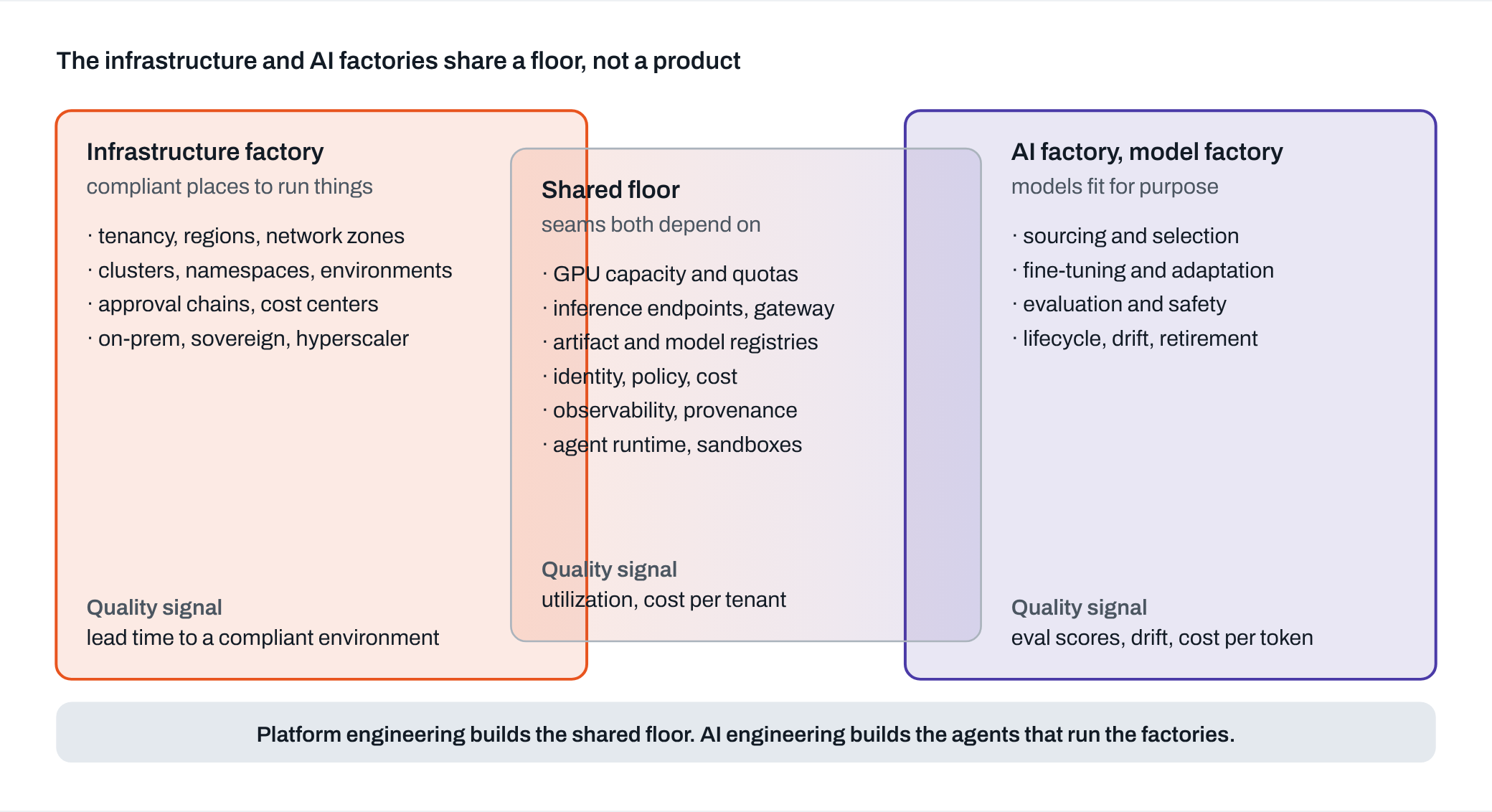
- GPU capacity and quotasAccelerated compute, held as inventory, metered per tenant.
- Inference endpoints and the model gatewayOne front door for every model call, with routing, rate limits and audit.
- Artifact and model registriesWhere images, packages, weights and evaluation results live, with provenance.
- Identity, policy and costWho may call what, under which policy, charged to which cost center.
- Observability and provenanceTraces, evaluations and decision records, kept where both factories can read them.
- Agent runtime and sandboxesIsolated execution for code and tools that agents produce.
- Data residencyWhere data and weights may live, encoded as a contract field, enforced as policy.
Capabilities and owners
Every capability has exactly one owner
| Capability | Owner | What the other factory does there |
|---|---|---|
| GPU capacity, tenancy, identity | Infrastructure factory | The AI factory requests capacity through the contract, like any other customer. |
| Model catalog, evaluations, routing policy | AI factory | The infrastructure factory stores and serves them but does not decide what is fit for purpose. |
| Inference serving | Infrastructure factory runs the serving platform | The AI factory owns what is deployed on it. |
| Model gateway | Infrastructure factory operates it | The AI factory decides where requests go. |
Overlap in the floor is a feature. Overlap in the product is a smell. Every capability has exactly one owner.
Dependencies
They consume each other
The software factory consumes environments
Every unit of work carries a target environment, and the infrastructure factory produces it.
The infrastructure factory's agents run on models
The agents that raise Terraform pull requests and run remediations call models the AI factory produced, through the gateway.
The software factory builds the code of both
Contracts, policies, vending lines and evaluation harnesses are code, and code comes out of the software factory.
The dependency is circular. That is the argument for one platform with three lines rather than three platforms: three platforms would each have to rebuild the floor the others already run on.
The glue
Two disciplines hold the three together
Platform engineering builds the shared floor
Platform engineering 2.0 is the discipline that builds and runs the floor: the contracts, policies, identity, cost and observability that all three lines stand on. It was never about building a portal. It is about letting factories run.
AI engineering builds the agents
AI engineering builds the agents that run all three factories: the coding agents of the software line, the evaluation and adaptation agents of the model line, and the provisioning and remediation agents of the infrastructure line.