Evidence

Why now

Code got cheap and environments did not. The figures below are the reason the infrastructure factory is a 2026 problem: code supply is up, delivery is flat, and the queue has moved from writing code to waiting for somewhere to run it. Every figure is self-reported by the organization that benefits from it. Read them as direction.

Live model

Where the queue forms

Two lanes receive the same work at the same rate. The software lane ships at agent speed. The environment lane stops at a gate. Switch the gate from a ticket to a policy check and watch the queue drain.

Ticket gate or policy check

Pull requests shipped0
Waiting for an environment0
Environments delivered0
Both lines receive work at the same rate. The software factory ships it at agent speed. Every change also needs an environment, and today that request stops at a gate a human opens a few times a day. Build an infrastructure factory and the gate becomes a policy check that answers in seconds. The queue is the thesis.

Evidence

The bottleneck has moved

In software factories, agents write most new code, around the clock, and engineers build the factories that build the software. But the delivery side has not kept up, and the gap shows in the telemetry.

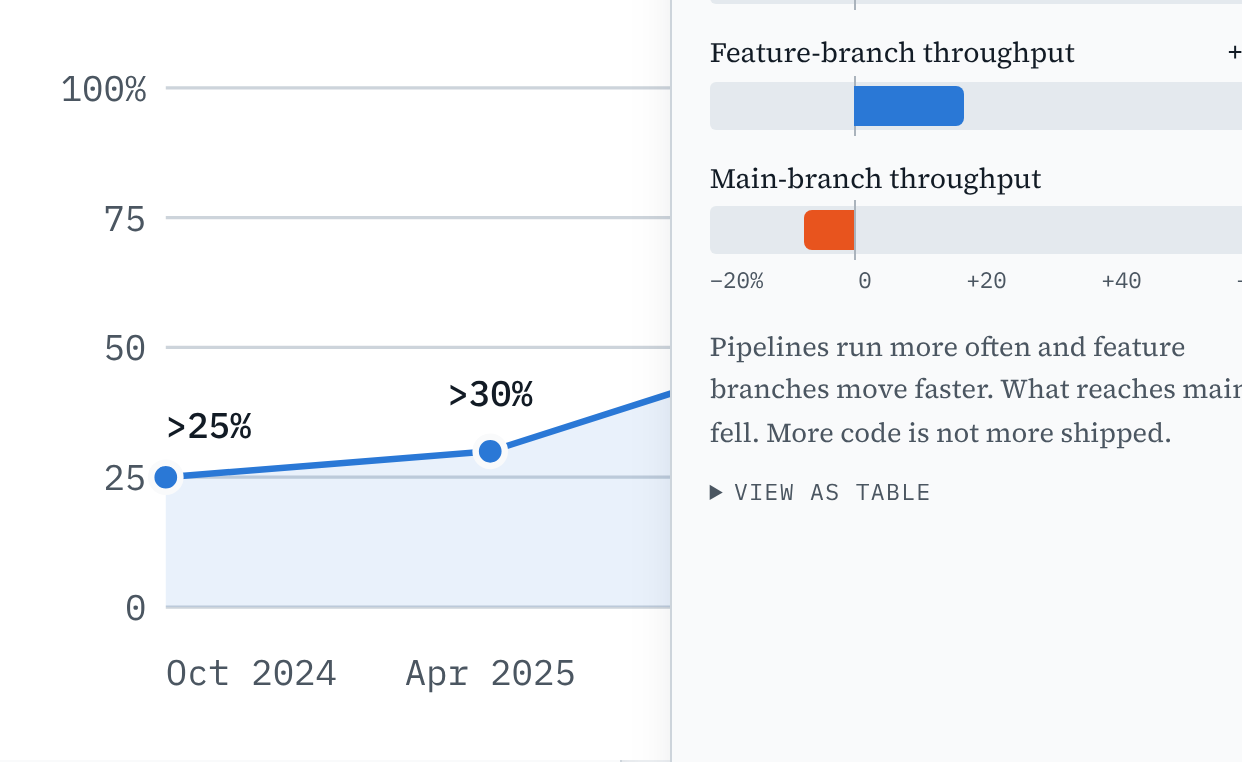
Code supply75%of new code at Google is AI-generated and approved by engineers, up from 25% in October 2024.Sundar Pichai, Cloud Next, April 20264
Code supply70%+of pull requests at Uber are attributed to local or cloud agents. Engineers have built more than 3,600 agent skills.Uber Engineering, August 20266
Code supply90%+of Anthropic's code is written by Claude Code, according to its CFO. Self-reported, and definitions vary between companies.Krishna Rao, May 20265
Delivery side+441%median time a change spends in review, while task throughput per developer rose 33.7%.Faros AI, AI Engineering Report 2026, 22,000 developers7
Delivery side−7%main-branch throughput for the median team, while daily workflow runs rose 59% year over year. Main-branch success fell to 70.8%, a five-year low.CircleCI, February 2026, 28.7 million workflows8
Delivery side16×growth in sandboxes on GKE in under five months after the Agent Sandbox preview, with 300 sandboxes per second claimed at GA.Google Cloud, May 20269

Share of new code at Google written by AI

Percent of new code, as stated by Google executives. The definition shifted between statements.4

100% 75 50 25 0 Oct 2024 Apr 2025 Fall 2025 Apr 2026 >25% >30% ~50% 75%
The April 2025 point is plotted at 30 for a statement of "well over 30%". Always quote the latest figure with "new" and "approved by engineers". Download PNG
View as table
DateShare stated
October 2024more than 25%
April 2025well over 30%
Fall 2025about 50%
April 202675%

More runs, less shipped on main

CircleCI, year-over-year change for the median team, 2026 report8

−20%0+20+40+60%
Pipelines run more often and feature branches move faster. What reaches main fell. More code is not more shipped.
View as table
MeasureChange
Daily workflow runs+59%
Feature-branch throughput (median team)+15%
Main-branch throughput (median team)−7%
Main-branch success rate70.8%

The acceleration whiplash

Faros AI, AI Engineering Report 2026, change across 4,000+ teams7

0+100+200+300+400%
Output per developer grew by a third. The wait after the code exists grew by a factor of five. Review is one station of that wait. Environments are the rest.
View as table
MeasureChange
Task throughput per developer+33.7%
PRs merged with no review+31.3%
Median time in review+441.5%

How to read these numbers

Every figure above is reported by the organization that benefits from it, and Faros covers only its own customers. Read them as direction. The direction is consistent across sources that do not share incentives: code volume rises, delivery capacity stays flat, and queues form after the commit.

The consultancies assume the delivery side will simply keep up. BCG Platinion's agentic SDLC ends in an "operation" phase where agents "automate deployment, monitor production, and remediate incidents"2. Factory.ai, which sells software factories, concedes that "almost no one has meaningfully instrumented this loop to be fully AI-driven"1.

Where the queue forms is the point

Review is the station everyone measures because it is the station that leaves a timestamp in the repository. The stations after it leave timestamps in ticketing systems: the staging environment, the new account, the firewall rule, the cost center, the compliance owner. Bunnyshell's summary of the same Faros data reads "AI writes code in minutes, your team waits days for staging"17.

No software-factory definition owns those stations. That absence is what this concept names.

Why now

Why this is hard right now

The market moves fast and we are swamped by changes in the way we do things. The first is the one no software-factory definition addresses, and the one the "AI writes your infrastructure code" vendors skip.

It's all about ownership, and not Terraform.

An environment request carries fields that no agent can sign: a cost center, a compliance owner, a data classification, an on-call owner, a network zone. Each is a human decision, made by hand, usually in a ticket, usually after the code already exists. StackGen's own example is a React application generated in three hours followed by two to three days of hand-written Terraform11, and that is before anyone asks who pays for it.

A factory cannot wait for those signatures. It has to encode them as defaults, delegations and policies, so that a request from an agent arrives already owned. Generating the Terraform faster does nothing for the fields a human still fills in. The table shows the same request twice: as it is resolved today, and as a factory resolves it.

Anatomy of an environment request: who resolves each field today and how an infrastructure factory resolves it
Field in the requestWho resolves it todayHow the factory resolves it
compute · network · databaseTerraform written by hand, or by an AI that freestyles it. human reviewsA golden-path contract exposes the choices the requester may make. The platform decides everything else. contract
cost_centerA manager approves it in a ticket. human signsInherited from the owning team's catalog record, with a delegated budget ceiling the agent can spend within. default
compliance_ownerNamed by a human after a review meeting. human signsA delegation rule: the service owner's registered compliance contact, enforced as policy. policy
data_classificationSomeone guesses "internal". human guessesDerived from the declared data sources. Higher classes need a human exactly once, when the contract is published. policy
on_call_ownerBlank until something breaks. nobodyInherited from the catalog. No reachable owner, no environment. default
network_zone · egressA security-team ticket. human signsDecided by policy from the classification and the contract. policy
lifetimeForever. nobodyA TTL by default. Renewal is a request like any other and carries the same owner. default

Capacity was sized for humans

Megaport asks whether coding agents are "the new CI bottleneck"17: validation capacity, meaning compute, caching and data movement, has to absorb agent spikes that arrive in bursts rather than at the pace of a working day. Bunnyshell makes the same point about staging17. CircleCI's telemetry shows what that looks like in aggregate: pipelines run 59% more often, and the median team ships 7% less on main8.

Trust moved downstream

Qodo's line, quoted by platformengineering.com, is that the bottleneck shifted "from writing code to trusting it"12. Gartner, cited by StackGen, expects better coding efficiency to create "a bigger backlog for code reviews and security reviews"11. StrongDM went furthest: "Code must not be written by humans. Code must not be reviewed by humans."3 To make that work it built behavioral clones of Okta, Jira and Slack to validate what the agents produced. Simulated environments on demand is an infrastructure-factory problem, whatever you call it.

Agents are a new kind of customer

Humanitec ships scoped, least-privilege service users for AI agents per project and environment16. Kubernetes SIG Apps added Agent Sandbox, with Sandbox, SandboxTemplate, SandboxWarmPool and SandboxClaim resources for "isolated environments for executing untrusted, LLM-generated code"9. The CNCF blog followed with "why sandboxing your agent is not enough"10. Gartner's 2026 Hype Cycle for Platform Engineering, as summarized by TrueFoundry, names "Agent Experience" and rates it transformational: back-end systems prepared so that APIs, data, documentation and workflows are machine-readable and discoverable20.

If your documentation is trapped in PDFs or your security policies are inconsistent, an AI agent won't fix it and it will simply fail more efficiently.Rickey Zachary, Thoughtworks21

Everyone assumes the other side keeps up

BCG's practitioners report productivity gains of 3 to 5x and factories where "as few as three engineers"2 run a line in which humans no longer write code. Their lifecycle ends with agents that "automate deployment, monitor production, and remediate incidents". TechTarget's survey of Robusta, Komodor and Akamas gives the operators' view: "platform engineering is about building platforms for AI agents, and the role of humans is to build a platform that agents can use effectively."18 Both sides describe the Infrastructure Factory from a distance. Neither builds it, because neither owns it.

Terrain

A cloud Infrastructure Factory is the easy case

Everything above quietly assumed a hyperscaler underneath: an API for every resource, capacity that appears in seconds, a meter on everything. That is the easy case. Many of the infrastructure that matters sits on something less cloud-like: a virtualization estate, bare metal, a sovereign or regulated cloud, factory floors and branch sites. The factory model holds there too. It has more stations and a harder first mile.

Virtualization48%of VMware customers plan to reduce their footprint by 2028. Only 4% have completed a full migration. The estate most factories vend from is itself moving.Virtified, April 2026; CloudBolt, February 202626
Sovereign cloud$23bnforecast European spend on sovereign cloud infrastructure in 2027, up from $6.7bn in 2025. Europe is expected to pass North America that year.Gartner, February 202627
Supply chain35 to 40weeks of lead time for server power-management chips in 2026, up from 21 to 26 weeks. Capacity off the cloud arrives on a truck, on a schedule the factory does not control.TrendForce, April 202630
Self-service83%of organizations say they need to increase or improve self-service provisioning of on-premises storage. The demand for the factory is already there; the APIs are not.Enterprise Strategy Group, August 2025, 380 organizations31

Cloud-likeness, defined

NIST's 2011 definition of cloud computing lists five essential characteristics: on-demand self-service, broad network access, resource pooling, rapid elasticity and measured service25. An Infrastructure Factory consumes all five. A hyperscaler supplies them as APIs. Wherever one is missing, the factory has to manufacture it before it can vend anything, and that is the whole difference between the cloud factory and every other kind.

NIST characteristicWhat a cloud factory gets for freeWhat a less cloud-like factory builds firstBuilding blocks
On-demand self-serviceEvery resource has an API: accounts, identity, networks, databases. Vending lines such as Account Factory already exist.APIs exist for compute (vSphere, OpenStack, KubeVirt), but network, firewall, IP addresses, DNS and storage sit behind tickets. The factory needs a source of truth and an API façade over every one of them.NetBox or Nautobot, Ansible, OpenTofu providers, Crossplane providers, Cluster API providers for vSphere, OpenStack and Metal3
Broad network accessA global backbone, managed load balancers, DNS and certificates on request.VLANs per site, firewalls with change windows, load balancers as appliances. The network has to become a policy the factory enforces instead of a ticket it waits for.MetalLB, Cilium or Calico network policy, cert-manager, external-dns
Resource poolingMulti-tenant by construction. Isolation is an account boundary.Dedicated hardware per team, licenses per socket, snowflake clusters. The factory has to create the pool: a virtualization layer, and tenancy inside clusters.KubeVirt, OpenStack, vCluster, Capsule, Kamaji, namespaces with quotas
Rapid elasticityCapacity appears in seconds and leaves the bill when released.Capacity arrives on a truck. Lead time has a floor set by procurement, so the factory keeps inventory: warm pools, buffer stock, reservations and forecasts.Metal3, Tinkerbell, Ironic, MAAS, Cluster API, SandboxWarmPool
Measured serviceA billing API, tags, and cost allocation down to the resource.No meter. Cost is a depreciation line in a spreadsheet. The factory has to build metering and showback before cost attribution can be one of its outputs.OpenCost with on-premises pricing, Kepler, Prometheus

Two things NIST does not list but a hyperscaler also supplies: one identity system across every resource, and a certified compliance posture under a shared-responsibility model. Off the cloud, the factory owns both. Keycloak and SPIFFE/SPIRE take the first; the evidence bundle from station seven takes the second.

What changes on the line

The first three stations do not change. Intent, contract and pre-check look the same whether the environment lands in an AWS account or on a rack in Nuremberg, and that is the point of the contract: the requester cannot tell where the environment will run, and should not have to. Everything between the pre-check and the hand-over is where the terrain shows.

Lead time has a floor the factory cannot remove: a VM from a warm hypervisor in minutes, a bare-metal node with firmware, RAID and an operating system image in tens of minutes to hours, a new rack in the weeks to months that 2026 component lead times dictate30. The factory's job is to hide that floor behind inventory, never to pretend it is zero.

StationCloud factoryLess cloud-like factory
1 to 3 · Intent, contract, pre-checkUnchanged.Unchanged. The contract hides the terrain.
4 · VendOne call to a vending line.Splits into capacity reservation, node provisioning (firmware, RAID, image), network and storage attach, cluster bootstrap, and the GitOps hand-off.
5 · SandboxAgent Sandbox on a managed cluster.The same, on a cluster the factory built. Warm pools matter more, because nodes do not appear on demand.
6 · AttachIdentity, telemetry and cost tags exist as cloud primitives.Identity federation and metering have to be built before they can be attached.
7 · Hand over, reclaimDelete the resources and the bill stops.Return the hardware to the pool, wipe it, and make it visible to station zero again.
0 · Supply (new)None.Procurement, inventory and forecasting. Capacity as stock, with a published fill rate.

Different terrains, require one contract

Hyperscaler cloud · the easy case

Cloud-like on all five counts

The vending lines exist: Account Factory, subscription vending, project factory. The hard stations are the non-technical ones, the fields no agent can sign. Factory effort goes into contracts, defaults and delegations, and almost none into supply.

Account Factory for Terraform · Crossplane · Kratix · OPA · Kyverno · Agent Sandbox

Virtualization estates · an estate in motion

APIs exist, self-service does not

vSphere, Nutanix, OpenStack, Proxmox and KubeVirt all have APIs. Few are exposed as self-service, because change advisory boards and per-socket licensing sit in front of them. The Broadcom licensing changes turned this terrain into a construction site: 48% of VMware customers plan to shrink their footprint by 2028, while only 4% have finished leaving26. KubeVirt, a CNCF incubating project heading for graduation with release 1.829, and Forklift for moving VMs are the open source route out. An IDC-documented enterprise cut provisioning from three to four days to about thirty minutes once self-service replaced its approval queue32.

KubeVirt · Forklift · Cluster API for vSphere and OpenStack · Crossplane · NetBox · Ansible

Bare metal and edge · physics in the loop

Capacity arrives on a truck

Factory floors, stores, telco sites and GPU clusters. In 2026, component lead times stretched to 35 to 40 weeks for power-management chips and 21 to 26 weeks for baseboard controllers, and HGX-class GPU systems quoted 8 to 20 weeks30. Thousands of sites with intermittent connectivity mean pull-based GitOps and immutable images. Here the factory ships images, not environments, and station zero is the one that decides whether a request at 3am can be served at all.

Metal3 (CNCF incubating since August 2025)28 · Tinkerbell · Ironic · Talos or Flatcar · Flux · Argo CD · Kepler

Sovereign and regulated · evidence is the product

The contract carries the jurisdiction

NIS2 applies since October 2024, the Digital Operational Resilience Act since January 2025 (the EU regulation, not the metrics) and the Data Act since September 202533. Gartner expects European sovereign cloud spending to more than triple to $23bn by 202727. Sovereign providers expose thinner API surfaces and fewer managed services, so more of the five characteristics fall to the factory. Data residency and operator independence become contract fields, and the evidence bundle from station seven is the artifact the regulator reads.

OPA · Kyverno · SPIFFE/SPIRE · Harbor · Zarf · Sigstore · OpenCost

The contract, the metrics and the first three stations are the same on every terrain. What changes is how much of the cloud the factory has to build before it can sell an environment. In the cloud, the factory is policy and ownership. Everywhere else, it is policy and ownership plus a supply chain. The hardest station in the cloud is a signature. The hardest station on bare metal is a truck.