Platform engineering in the agentic era · Working concept · October 2026 · Max Körbächer
The Infrastructure Factory
Everyone is building software factories. Nobody has built the thing they run on.
A platform that turns intents from humans or agents into compliant, owned, observable, cost-attributed environments, with no ticket in the path.
The shift
Code got cheap. The environments it needs still move through tickets.
Agents now write most new code at Google, Uber and Anthropic, and the pull requests arrive in minutes.465 What each one needs next, an environment with an owner, a network position and a budget, still moves through a ticket that a person opens a few times a day. Review time quadrupled and main-branch throughput fell. The gap between code supply and delivery capacity is where the queue forms.
All three figures are reported by the organization that benefits from them. Read them as direction, not precision.
Live model
The queue is the thesis.
Two lanes receive the same work at the same rate. The software lane ships at agent speed. The environment lane waits for a ticket.
Three roles
Infrastructure plays three roles in a software factory
It is under the loop, inside the loop, and the source of the next signal.
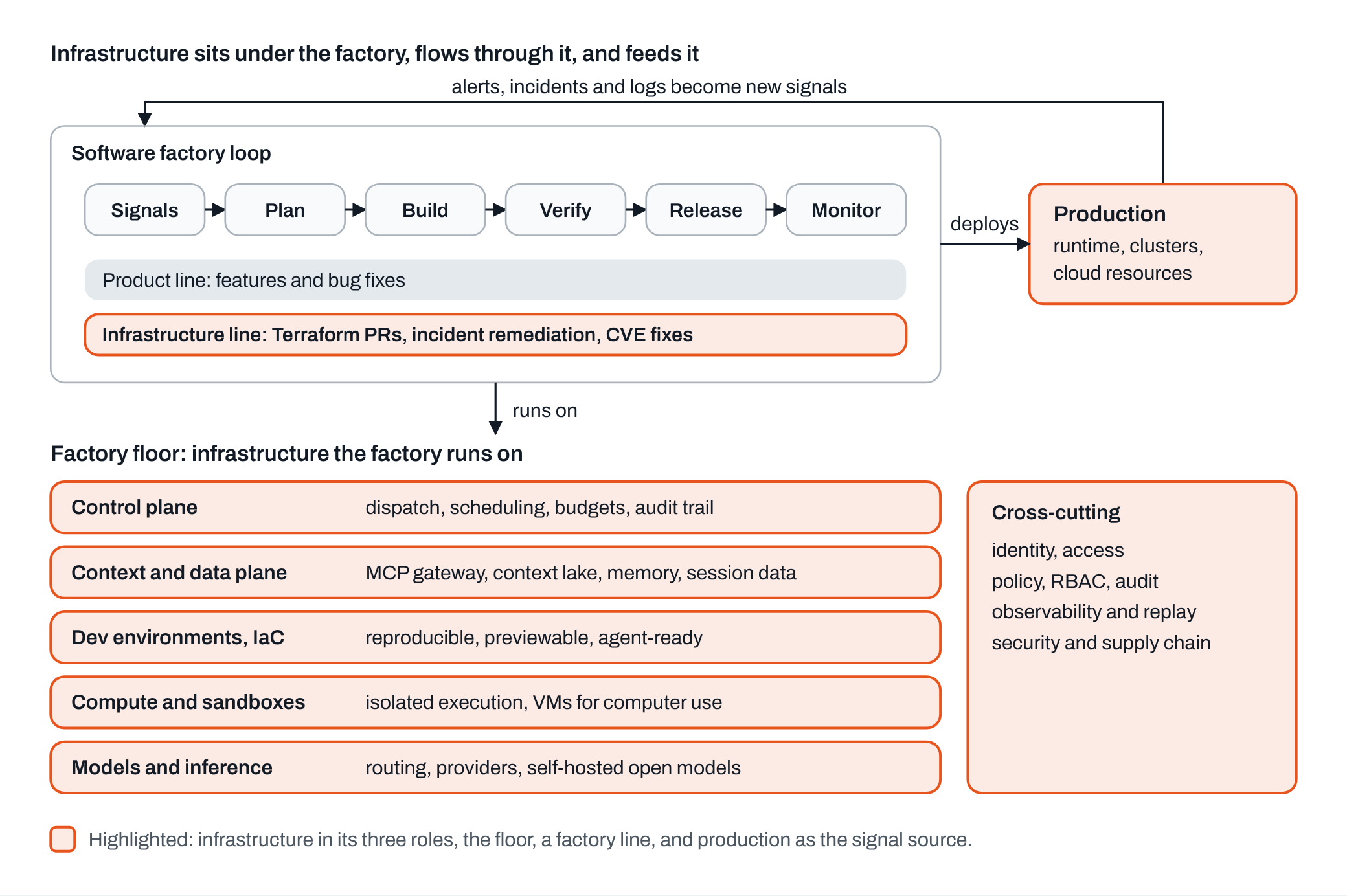
The software factory sources agree on the first role and take the other two for granted. The floor is the infrastructure the loop runs on. The line is the infrastructure work the loop carries, which Port already runs as factory lines.44 The signal source is production itself: a factory that cannot see its environments cannot start the next loop. One platform supplies all three, and that platform is the infrastructure factory.
The floor it runs on
Control plane, context plane, environments, sandboxes, models and inference, with identity, policy, observability and supply chain across all of them.
A line it runs
Terraform pull requests, incident remediation and CVE fixes move through the same gateway, evaluations and release control as product code.
The signal source
Alerts, incidents and logs from production start the next loop. A factory without the floor has nothing to monitor.
Not NVIDIA's AI factory
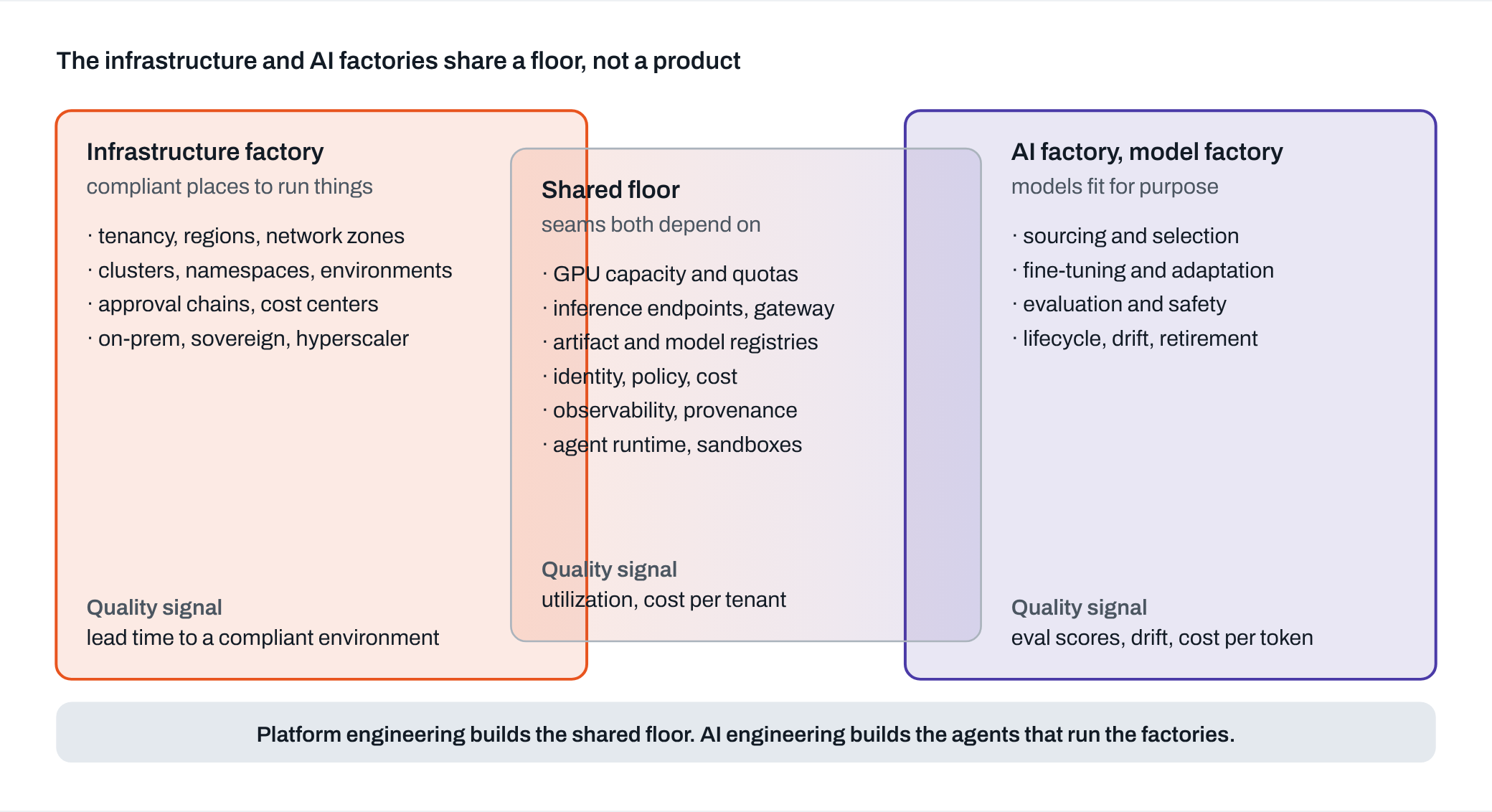
Not NVIDIA's AI factory, but it overlaps
NVIDIA's AI factory turns power into tokens.48 That is infrastructure specialised for accelerated compute, and under that reading it is an infrastructure factory with an unusual product mix.
The infrastructure factory produces environments: places to run things that arrive owned, compliant, observable and attributed to a cost center.
An AI factory in the model sense produces models fit for purpose: sourced, adapted, evaluated, registered and served.
The two share a floor and nothing else: GPU quotas, inference endpoints, registries, identity, policy, cost, observability and sandboxes. Every shared capability has exactly one owner.
What it takes
What it takes to be one
- Intent in, environment out. The request names purpose, owner, data and lifetime. The product is a place to run things, not a list of resources.
- No ticket in the path. Humans decide once, at the contract. Nobody decides per request.
- Policy before provisioning. Allow or deny, with a reason the requester can act on, before anything is built.
- Ownership and expiry by default. Cost center, compliance owner and on-call are inherited. Everything has a lifetime.
- The factory measures itself. Lead time, zero-touch rate, time to owner and orphan rate, published to its customers.
Most teams are somewhere on this ladder. Find your stage, then read what the next one removes from the path.
- 0Ticket desk
- 1Automated fulfilment
- 2Self-service portal
- 3Contracted API
- 4Infrastructure factory
Where to start
Start with the sandboxes
The first vending line is ephemeral sandboxes for coding agents. The demand exists already: sandboxes on Google Kubernetes Engine grew 16x in under five months after the Agent Sandbox preview.9 A sandbox needs an identity, a lifetime and a policy, and nothing a human has to sign. The second line is preview environments per pull request, where ownership defaults and cost attribution get exercised at volume. The third is production vending, by which time the contracts, policies and inventory already exist.